10/19/26
Athena is the Girl-Boss Here
Athens, Greece
Arriving in the dark (and after our collective bedtime), we had no idea what awaited us outside the windows of our apartment. The alarm went off a couple of hours before we would have liked, but if we slept longer, we would miss our guided walking tour of the Acropolis. This is one of the specific places I wanted a guide because of the deep Greek history and the theological framework that lives centuries of layers under the surface. We are now 9 hours ahead of U.S. Mountain Time, our usual time zone. This is the farthest east we are traveling during our 100-day journey outside of the United States.
I had a fleeting thought that we should skip this leg because of our mounting sleep debt and fatigue, however, I knew we might find some sacred pieces of our journey in Greece.
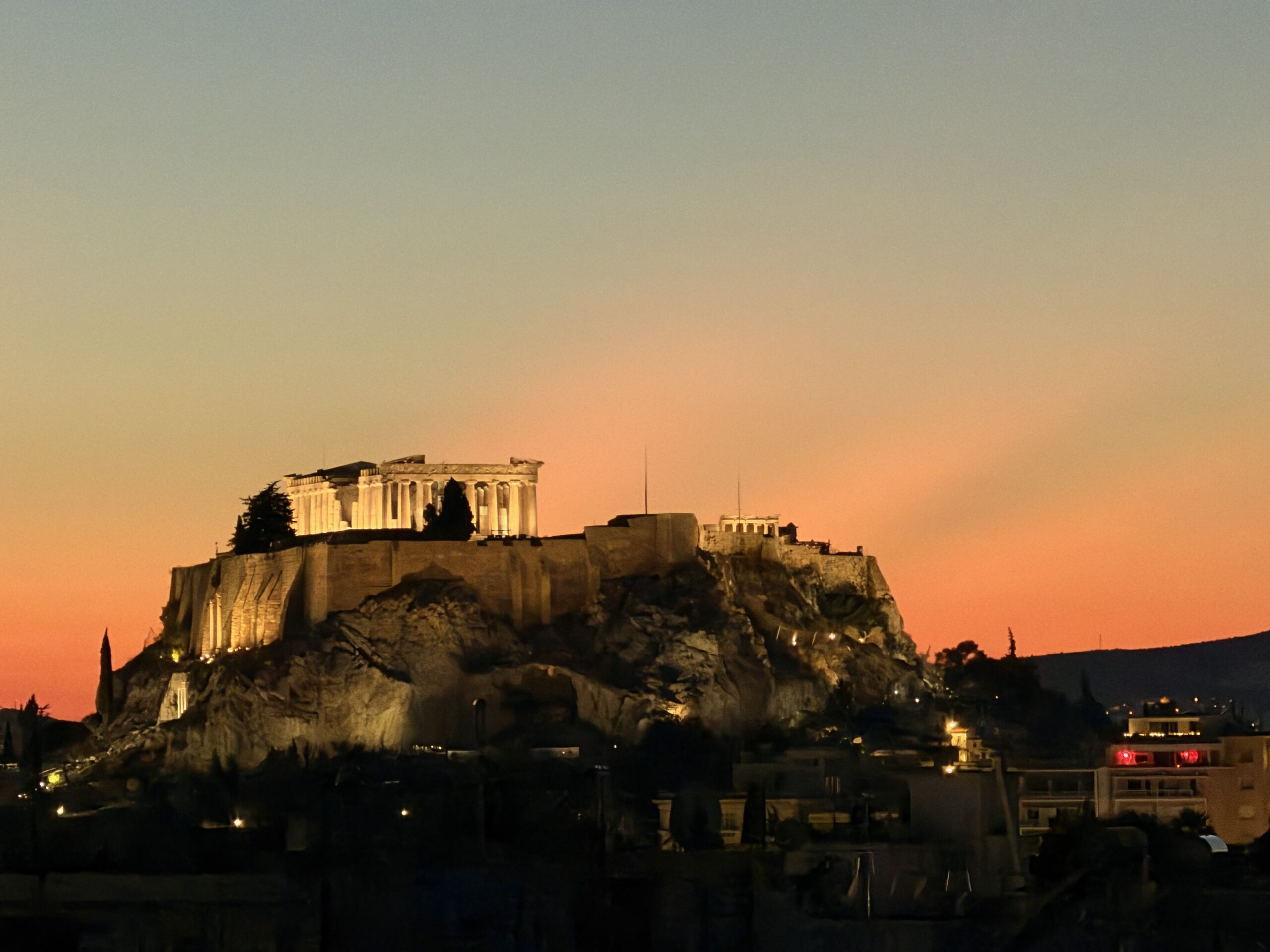
In the morning, we looked out the windows of our apartment, amazed by the endless series of white apartment buildings fanning out around the Acropolis. Ready with our walking directions, and thankful it was a slower day (Sunday), we set out to find our tour company. I was impressed with the young women in the tidy and modern office of the company called Athens Walks. We joined up with the blue group and started walking, with about 20 others and our guide, toward the Acropolis.
I was seriously naive about what we were going to see. I thought it would be a path to the Parthenon and a view of the city, and that’s it. But it was so much more! Starting from the very beginning of what archaeologists have uncovered, there are ruins and artifacts with the Greek language from the 15th century B.C.E. (Before the Common Era).
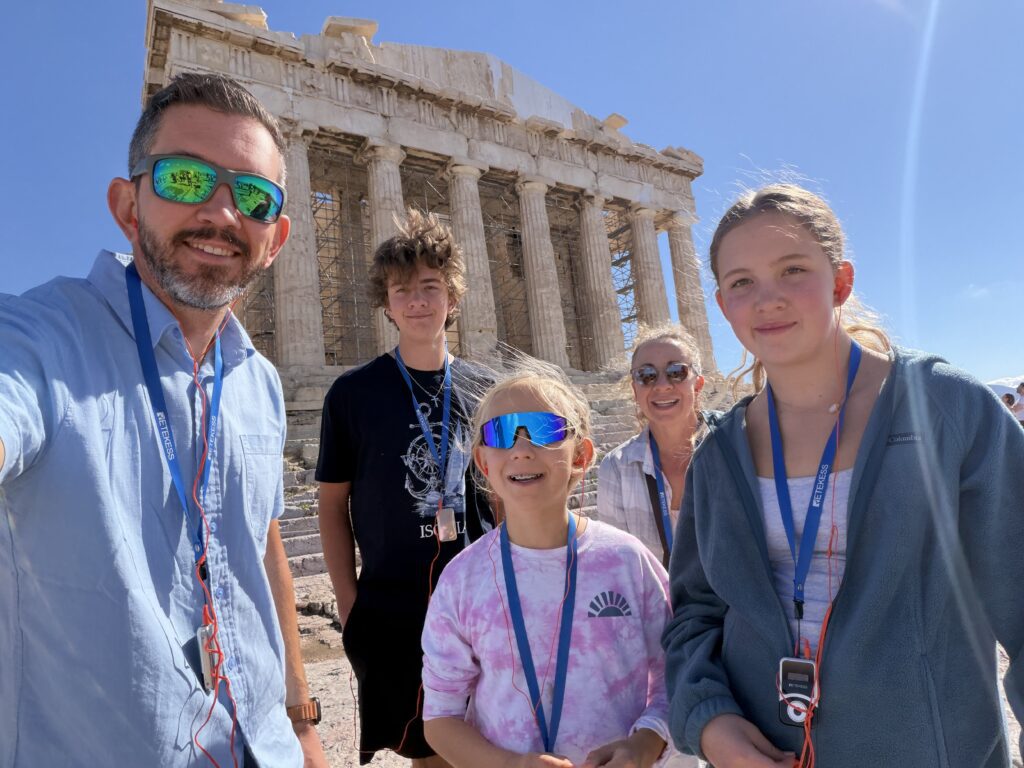
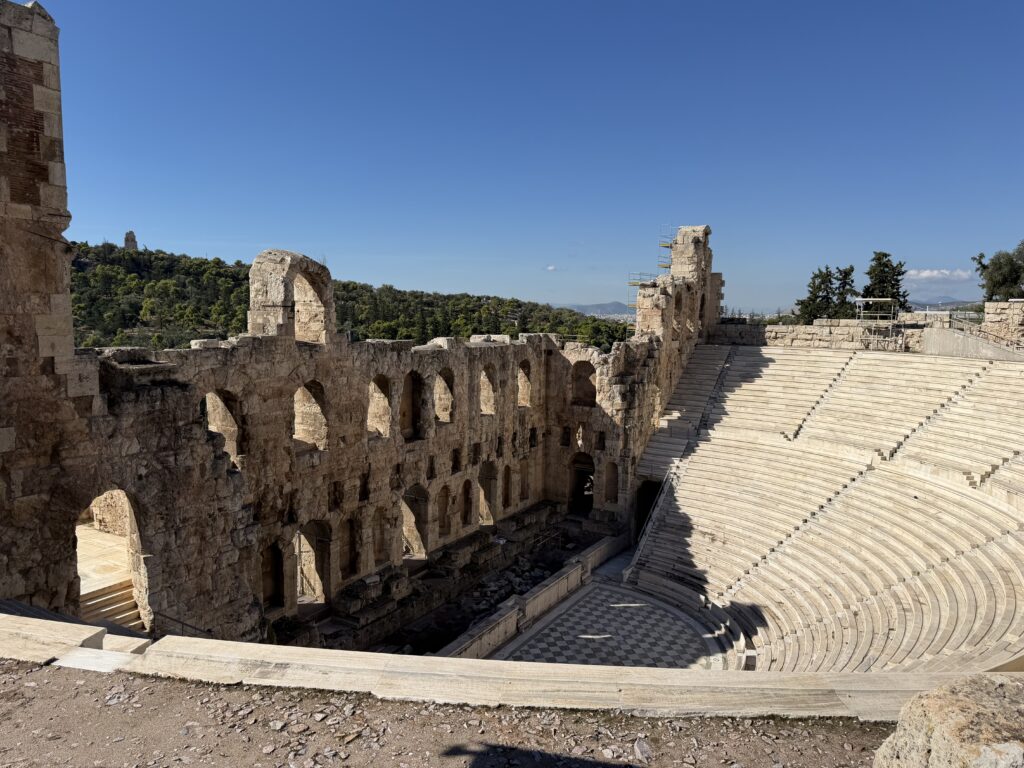
Greek words tell a story and almost always give you the root behind the word that carries a deep meaning or connection. Acropolis, as a word, comes from Acro (farthest part) and Cropolis (place). It is the whole mountain on which many temples and theaters were built and a myriad of historical events took place. At the height of Greek culture and power, in the 5th century B.C.E., the 12 gods of mythology and their origin stories reigned supreme.
I am not even a novice Greek historian, but I took as many notes as I could as our guide fascinated us with stories of each place we stopped at along the way to the top:
- Dionysus – the god of wine and fun – inscriptions from the Mycenaean period – the god that liberates the spirit – a theater dedicated to him at the Acropolis – comedies and tragedies were performed – this was important because they had political commentary, especially in comedies (satire) – tragedy comes from the Greek word for goat (they use mythology) – war was frequent
- Apollo – the god of music and harmony – theaters had sponsors (they got their name on monuments – sound familiar nowadays?!) – fame – their name was preserved – this theater of Apollo was built by a tyrant – his sons were horrible and the guys who killed them were praised for saving democracy – it continued to be renovated
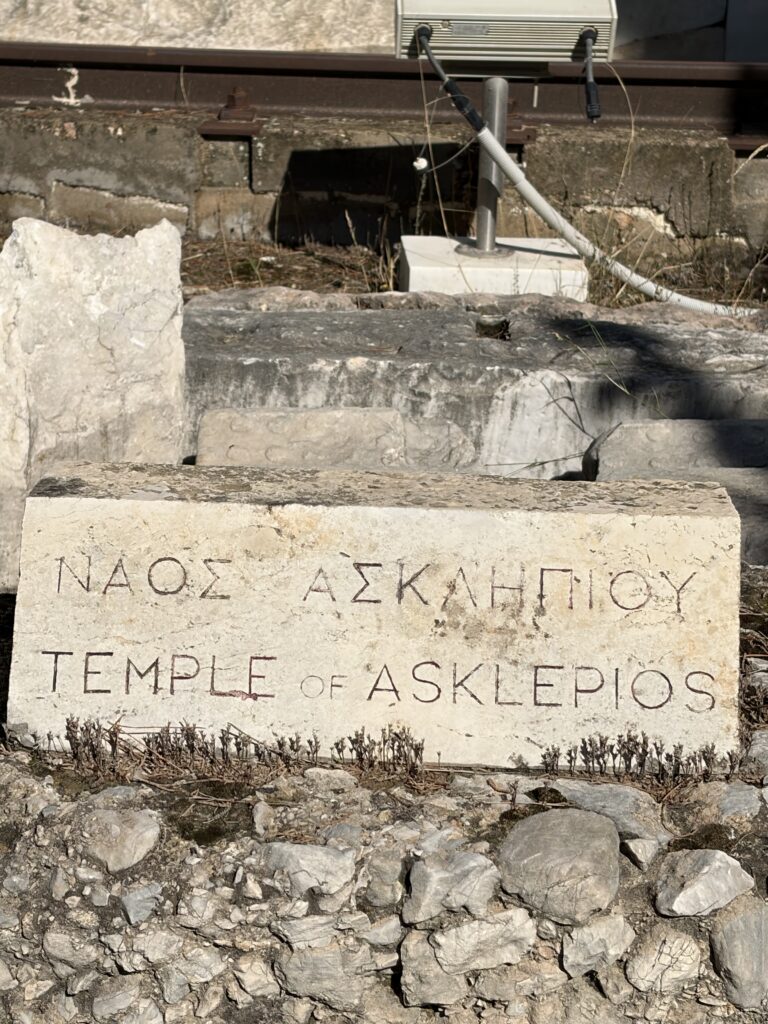
- I had to look this one up! … The name you are looking for is Asclepius (pronounced uh-SKLEE-pee-uhs, written as Asklēpiós in Ancient Greek) – the god of medicine – an ordinary man who claimed to be son of a god – one could become venerated as a god – he was said to bring people back to life (the god, Hades, did not like this – he was the god of the underworld) – followers of Asklēpiós, the priests, could cure you – you would dream your way to help – they would say you will be cured (the placebo effect is a thing) – Hipócrates- also a healer and doctor said “cure of the patient is above all” and doctors still take a Hippocratic oath to practice medicine
- Zeus – was the son of a god – was obligated to do something about the fact that Askraeperos claimed to be a god – so he struck Askraeperos with lightning and he went to the underworld – then he really was venerated as a god
In the ancient Greek religions, all gods were anthropomorphic – they were immortal so they could do extreme things. In the 5th century B.C.E., the height of Greek power, they must fight off the Persians so they emphasized the building program to create the sculptures like the 12-meter-tall chryselephantine (gold and ivory) statue of Athena. This statue was surrounded by columns and the huge gate of the first big temple. They felt threatened and needed to show their power by building something that would exude power. Again, I could not stop myself from thinking of current events.
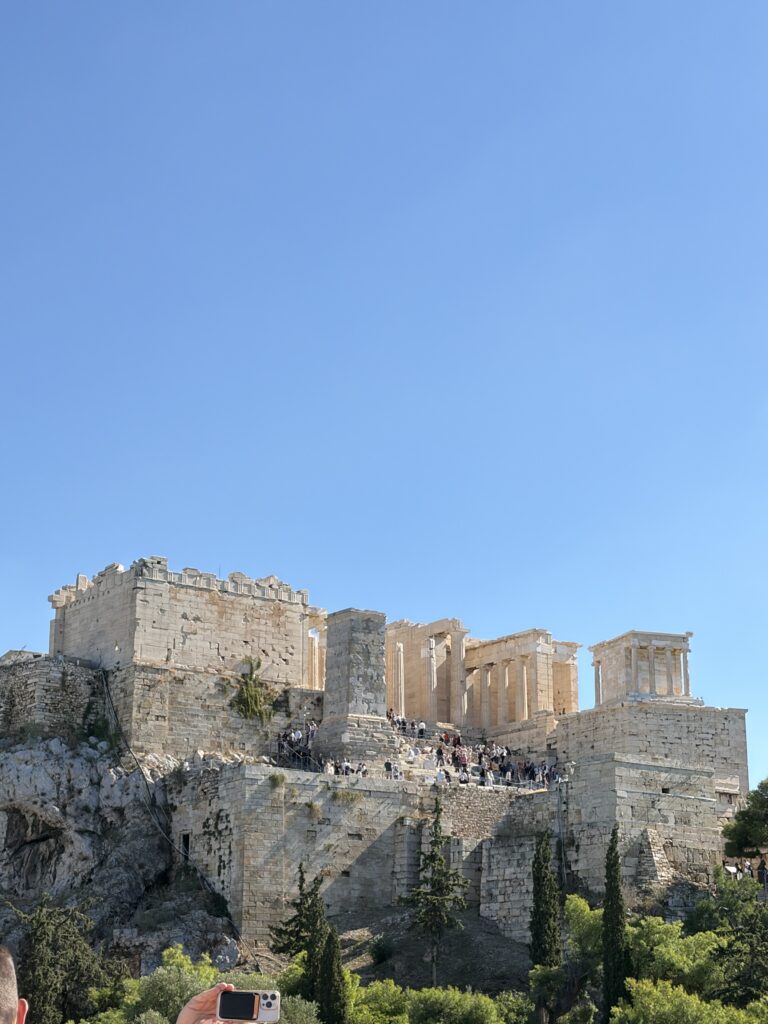
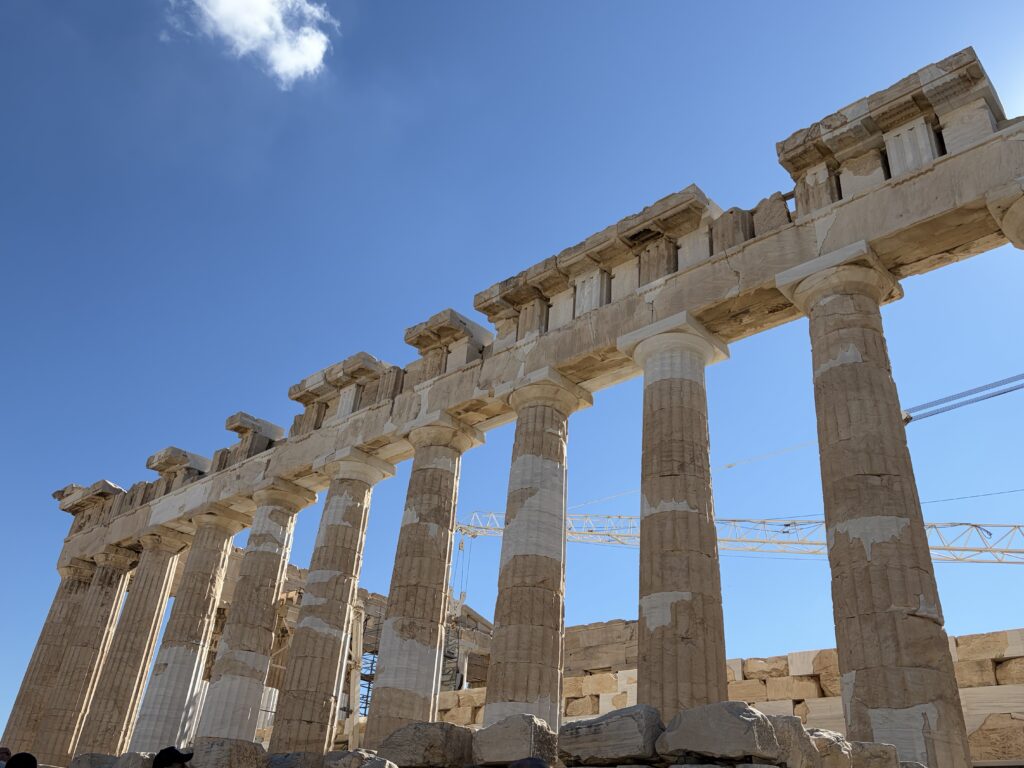
Then, the Parthenon was built and dedicated to Athena. Athena was the favorite daughter of Zeus. She is the goddess of wisdom and weaving (crafts) – and protector of the city. Athena had the desire for peace – the olive branch was a symbol of peace and she gave an olive tree to end the battle. Olive trees are everywhere in Greece and olives (and olive oil) is the favored appetizer. Poiseidon was mad at Athena so he started to strip women of power – they had a battle – women warriors and gods and half humans all in battle. War needed propaganda so the symbols in the Parthenon are those sculptures and images of past Greek gods and myths. The humans were placed close to the gods, especially in their minds, and it was the hubris that brought down the Greek superpower in real life.
For decades, the ancient Greek world was split between two superpowers: the democratic, naval-based Athenian Empire and the oligarchic, land-based Spartan alliance.The Athenian Empire lost to Sparta in the Peloponnesian War, 431–404 BCE, and were ruled for 34 years by the Spartans.
Acropolis: Its History, Buildings, Temples and Archaeology
The Parthenon is one of the best known architectural symbols of any civilization. Built in the 15 year period between 447-432 B.C. this ancient Greek temple was designed as a replacement for a temple destroyed by the Persians in 480 B.C.
However grand the buildings with which Peisistratos adorned the Acropolis , they did not survive the Persian onslaught. Fortunately, many of the buildings erected by Pericles a half century later have survived, and it is the Periclean Acropolis which we visit today. Of these buildings, the most famous is the Parthenon (447-32 B.C.), flanked by the temple of Athena Nike (427-24 B.C.) and the Erechtheion (421-06 B.C.). In addition, Pericles was responsible for the building of the Propylaia (437-32 B.C.), the monumental entrance way to the Acropolis
As we prepared to leave the top of the Acropolis and its many temples, I felt the weight of humanity. Humans, with all of our flaws, are destined to fall. The Greek concept of hubris, excessive pride, was a huge theme of tragedies and comedies alike. And I thought about Greek mythology and the love for gods who are immortal and flawed and able to hold all of their flaws in tension as they live out-sized lives of battle and passion and family feuds. And then, I thought about religion and how it has formed its ways, its traditions, its origin stories around these same themes. And at the center of so many powerful ruling governments was religion, or a version of religion, that either saved or condemned people based on a variety of subjective pieces of interpretation.
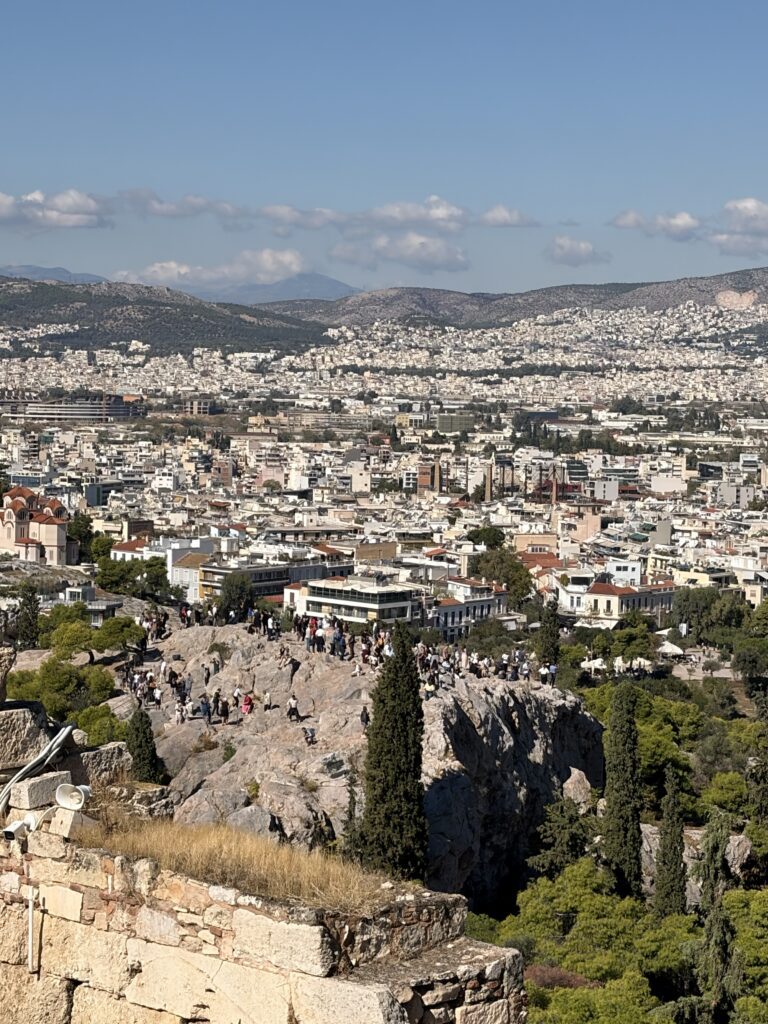
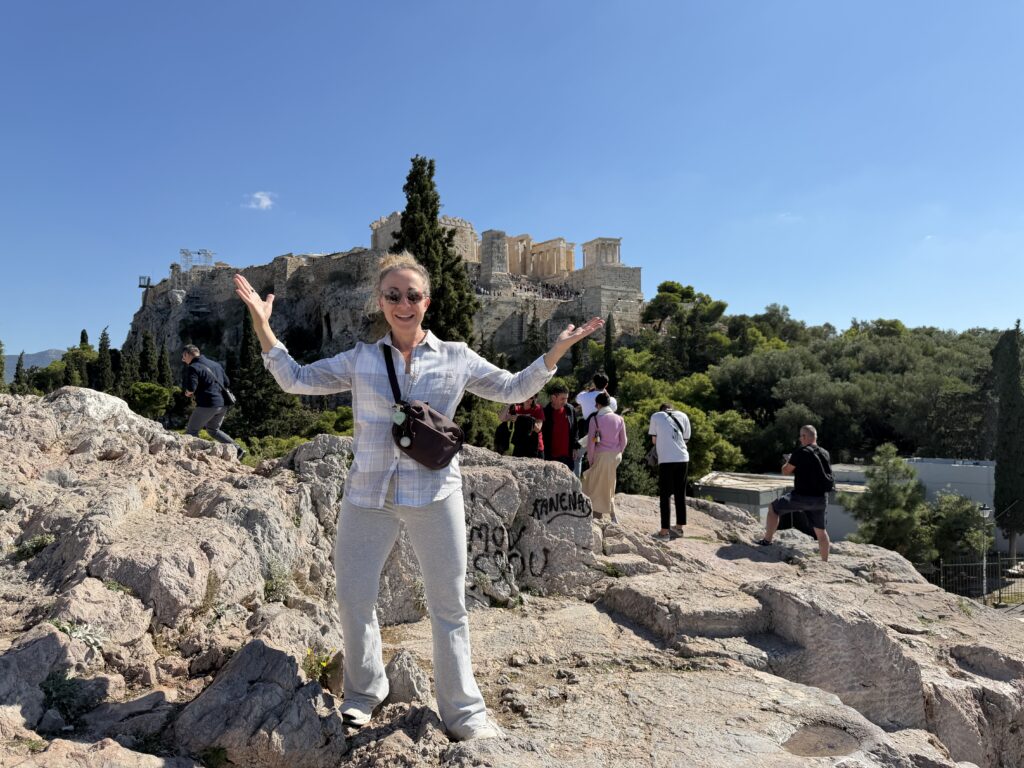
Before I exit this post, and just as we exited the acropolis, we saw the hill with people dotting it like ants. This hill became a very important place for Christianity as Paul, follower of Jesus, and the author of many of the letters in the New Testament, preached here, with the acropolis and the mighty temples at his back. It could not be any clearer that he was juxtaposing the power and domination of the past with this new “way” of following Jesus.
There is another post brewing about theology and knowing …
No responses yet